
The Richmond Group
by Nevin M. Fenneman
from the
Geological Survey of Ohio, 4th Series
Bulletin 19
Columbus 1916
General Character
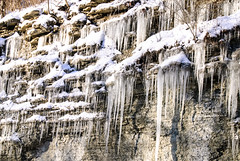 The foregoing descriptions complete the list of formations exposed in the immediate vicinity of Cincinnati, except for the ridge extending north from Westwood. Those who know the hillsides and streams a little farther north in the vicinity of Lebanon or of Oxford have encountered certain familiar forms which are unknown in the quarries and streams near Cincinnati or even Hamilton. Among these the most familiar are probably the large solitary corals having about the shape and size of "calves' horns." The presence of these indicates a higher group of rocks known as the Richmond. This higher group has been almost completely stripped by erosion from the vicinity of Cincinnati, but outcrops in a broad band thirty to fifty miles from that center where the uplift was less. Its lower formations cover considerable areas in the Hamilton and Mason quadrangles. The group as a whole is fairly well represented in the northwest corner near Oxford where it caps the higher uplands. The name of the group is taken from Richmond, Ind., where it is well exposed, and has been thoroughly studied. Where well developed it is about 300 feet thick.
Most of the Richmond is even-bedded, with clean cut alternations of limestone and shale, in this respect strongly resembling the Maysville. The limestone beds vary in thickness from two to ten inches (generally less than six inches) and comprise less than half of the whole mass, perhaps not more than one-fourth. On the whole the color of its limestones is less blue and more gray or dove colored than that of the Maysville. But these physical distinctions are relatively unimportant and not sufficiently uniform to be trustworthy for purposes of identification. The real and essential distinction is in the fossils. These show that the sea was inhabited by a very different fauna during the Richmond epoch from that which lived in the previous epochs The advent of corals is only one of the many changes.
Formations
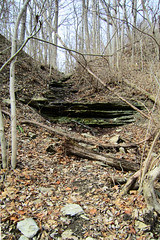 The lowest formation in the Richmond group is the Arnheim shale. It rests on the Mount Auburn and is about eighty feet thick. It consists largely of dark bluish shale with a subordinate amount of blue limestone. In part it is even-bedded like most of the lower formations, but it has other portions, especially near the top, which look like the Mount Auburn. In these the limestone occurs in rough irregular beds, or nodules with scraggy masses of indurated clay, strongly contrasted with the regular bedding above and below.
The next fifty feet of the Richmond is called Waynesville shale. To a casual view it is not unlike most of the other formations but at many places its gray or dove colored limestone, associated with strikingly blue or greenish-blue shales, gives something of distinction to its appearance. Its shales are sometimes highly calcareous or marly. It is well exposed near Oxford. Above the Waynesville are thirty-five feet of beds, known as the Liberty limestone, which differ little from the Waynesville except in fossils, though the limestone layers are more abundant and bluer. All that lies above the Liberty in this area is included in the Whitewater formation. The physical characteristics of this are not unlike those of the Mount Auburn beds of the Maysville. It lacks the clean-cut even bedding of the formations immediately below it. Both its limestones and shales have a rough concretionary or nodular appearance. While blue in places, the color is more generally brownish or yellowish. Much of the limestone is very impure.
The full text of Geology of Cincinnati and Vicinity is available online via Google.







Did You Know?
Follow Us


Contact Us
| Email: | info@waynet.org |
| Phone: | 765.939.0857 |
| Mail: | 50 North 5th St. Richmond, IN 47374 |
| Director: | Board of Directors |
Stay in Touch
Sign up for WayNet News
- our e-newsletter.